

French Cinema on the Bulgarian Screen
By Petya Alexandrova
The surprising thing about determining the presence of French cinema on the Bulgarian screen is the total lack of surprises. Its influence began with the very birth of cinema and has unfolded in the traditional and predictable manner. French cinema emerged as a powerful alternative to the mainstream or “official” currents, especially when it ceased to be the mainstream itself (following the end of World War I).
Whether compared to American or Soviet cinema, whether driven spontaneously by the market or imposed ideologically – mass cinema is not French, and French cinema is not mass. It hasn’t been for a long time – not since the end of the First World War – when, according to the French film historian Georges Sadoul, France irrevocably and forever lost its dominance in cinema[1]. A misguided Francophile might perceive this as a tragedy. I find it to be more of a success – in this way, it enters a unique pantheon of the alternative and the anti-conformist. And I believe many of the creators themselves would prefer their films to be perceived in this light.
French cinema has transformed into a territory of “otherness”, yet an “otherness” that remains acceptable. Something akin to “moderate progress within the bounds of the law”. A sense of difference with which one can easily identify. And where being entertained is a mandatory – albeit insufficient – condition. To watch French cinema – yes, French cinema carries a flavor of intellectuality; it is chic. Today, this implies placing the auteur above the story and style above substance.
The influence of French cinema on Bulgarian cinema is vast: it manifests in the screening of films on the big, studio, and small screens; in translated articles and the reading of French magazines; in co-productions and the participation of Bulgarian artists in French films (and vice versa); in education and specialized training in France; in the short-lived aid fund for Eastern European cinema; in Eurimages, and so on. The results can be found in the personal taste of most viewers and the individual style of many filmmakers. I will focus on only one aspect – the presence of French films on the Bulgarian screen (excluding television). I will intentionally look back to the dawn of cinema so that the facts – always vulnerable to speculation – may sound more impartial and sufficiently objective.
The Repertory Through the Years
Albeit slightly later than in other European countries, the first film screening in Bulgaria featured a program of short films by the Lumière brothers. It took place on February 27 (March 13), 1897, in Ruse. The effect was the same as everywhere else – amazement at the moving image (especially the swaying leaves in the background of Baby’s Breakfast), terror at the oncoming train (The Arrival of a Train at La Ciotat Station), and admiration for the possibilities of the “cinematograph”. “A miracle!” – this was the universal reaction. The same program triumphed across the globe. French cinema flooded screens everywhere, and Bulgaria, though bringing up the rear, followed the general trend.
Here is the Bulgarian film repertoire from the silent era. According to Kostadin Kostov’s notes for the period 1908–1930 [2], about 1,000 French titles were screened, including not only feature films but also the documentary newsreels of Pathé Journal. Referring to Georges Sadoul’s History of the Art of Cinema, the key French titles were also shown here. These included the Zigomar and Fantômas series, numerous adaptations such as Carmen, Les Misérables, Nana, and others. There were also milestone films like The Assassination of the Duke of Guise, associated with the film d’art movement, and Napoléon, Abel Gance’s polyvision ambition. They shaped audience tastes and cultivated a specific public. There were discrepancies as well – as Sadoul laments, even in Bulgaria, the films of the French avant-garde (Delluc, René Clair, Luis Buñuel) did not achieve mass distribution, despite later being studied in film schools. Curiosity toward them remained in the realm of experimentation, as they are still perceived today.
However, the French films of the silent era that were most easily assimilated and quickly absorbed – not only by audiences but also by filmmakers – were the comedies. The first French comedian, André Deed, was Bulgarized in local titles with the nickname Ivancho. The repertoire included Ivancho at the Ball, Ivancho in the Library, Ivancho and the Criminals… The other star, Max Linder, was also represented in many titles. If you have the chance, look closely at the photos of the first Bulgarian actor and director –Vasil Gendov. Who does he remind you of in the oldest surviving native feature film Love is Madness? Is he not a cross between the cunning of André Deed (but smarter) and the gallantry of Max Linder (but less refined)? Heavy makeup, exaggerated mimicry, buffoonery, and a comical elegance, abstract plots outside of time and space – that is the “Vasil Gendov style”. It is also the style of French comedy and the melodrama of that era.
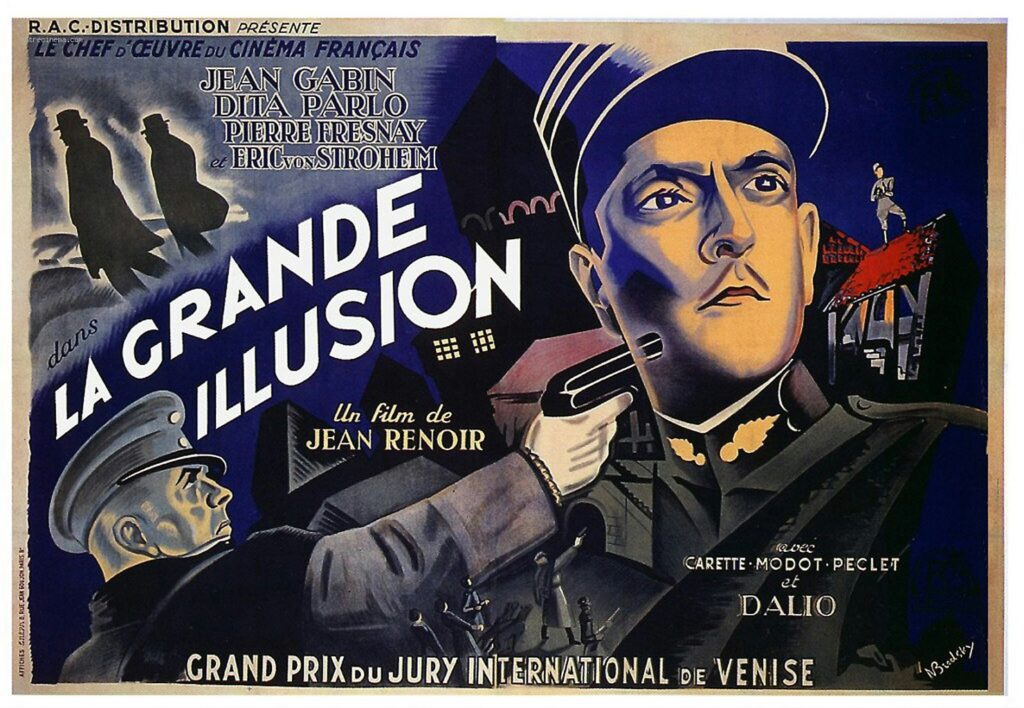
Did anything change with the advent of sound? According to Kostadin Kostov, between 1930 and 1944, about 370 French titles were screened in Sofia cinemas. Among them were the titles cited by Georges Sadoul, such as Grand Illusion, The Heroic Keremesse, La Belle Équipe, Un carnet de bal, Liberty for Us, Les Misérables, The Phantom Chariot, Le Million, Pension Mimosas, Pépé le Moko, and Under the Roofs of Paris –essentially the entire French canon from the powerful era of poetic realism. Thus, contrary to expectations and despite diplomatic relations not being at their peak, good films broke through to the big screen.
According to Alexander Yanakiev: The 1940s were a more specific decade. World War II had begun, and in 1941, Bulgaria entered it on the side of Germany. Consequently, in the first half of the decade, the screening of American, British, French, and Soviet films was restricted. After September 1944, German, Italian, and Hungarian films were completely halted, and all old American, French, and British films found in the country were pulled out, while new titles were feverishly sought from the USSR, the USA, France, and Great Britain. By 1945, significant success had been achieved – according to some reports, the repertoire that year consisted of 316 titles from 11 countries, with more than half being American and 78 Soviet [3].
This detailed “prehistoric” account proves the constant presence of French cinema on the Bulgarian screen. Regardless of changing social conditions, its triumphant march never stopped. According to Georgi Angelov, within the century following the first screening on February 27, 1897, in Ruse, about 3,000 French films were shown [4]. Thus, according to Alexander Alexandrov, French cinema ranks fourth after American, Soviet, and German cinema (including GDR cinema) [5], which is indeed its true standing.
Immediately after World War II, it seemed that French films had been in disfavor from the late 1930s to the mid-1940s. In a sense, this was true – they did not dominate the screen. However, this does not mean that worthy films did not find access, even if they weren’t always programmed well or on time. Renoir’s Grand Illusion, for example, was made in 1937 – during a time of strained political relations – not to mention its anti-war pathos and deep pacifist meaning. Yet, it made it to the big screen. After the nationalization of cinema in 1948, another accusation spread – one of pro-German (up to 1944) or pro-American (between 1944 and 1948) leanings. While these existed, they did not exclude the valuable presence of “progressive” French films. Later, throughout the socialist period, French cinema was quantitatively well-represented, and innovations like the French New Wave, despite everything, passed through the needle’s eye of censorship. For over a century, the repertoire has indeed developed in fits and starts, but it has never absolutely turned its back on genuine achievements.
This remained true after the social cataclysm of November 1989. Soviet films vanished – but in fact, the Soviet Union itself vanished. American films flooded the screens, but that is the reality everywhere in the world – the free market determines taste preferences toward that specific cinema. Joël Chapron, UniFrance distributor for this region, complained in his opening speech for French Cinema Week in February 1998 in Sofia that the distribution of French films in Bulgaria was the weakest compared to other Central and Eastern European countries. However, the same could be said for British, German, or any other cinema. The share of distribution is determined by the size of Bulgaria, the number of cinemas, the economic situation, and many other factors, but not by taste preferences.
French cinema continues to occupy its specific niche – not in the top position (which would be excessive), but not pushed to the back (which would be unjust) – and in parallel screenings outside the big screen. French Film Weeks have existed, do exist, and will continue to exist! They officially began in 1957 and continued in 1965, 1966, 1970, 1977, 1985, 1987, 1997, and 1999 (films of the ’90s). For comparison – in countries like Italy and Russia, there are annual UniFrance festivals. In Bulgaria, specialized screenings are also organized: for example, historical epics for the 200th anniversary of the French Revolution in 1989 (including La Marseillaise, Marie Antoinette, Dialogue of the Carmelites, Danton, etc.); the anniversary of Cahiers du Cinéma in 1992 (featuring the key films of the French New Wave); Jean-Pierre Melville and “film noir” in 1996; the Panorama of Young French Cinema in 1998, and so on. There have also been major retrospectives of Jean-Luc Godard, Louis de Funès, and François Truffaut. What more could one ask for from figures and facts?
[1] Sadoul, Georges. History of the Art of Cinema (Histoire de l’art du cinéma). Sofia: Nauka i Izkustvo, 1959, 37.
[2] Kostov, Kostadin. Bibliography of Cinema in Bulgaria. Archive of the Bulgarian National Film Archive (BNF), 56.
[3] Yanakiev, Alexander. Cinema Bg. Sofia: Titra, 2003, 198.
[4] Angelov, Georgi. Young French Cinema Has Arrived in the Capital. – Demokratia, No. 73, March 20, 1998.
[5] Alexandrov, Alexander. Contemporary Problems of Western Cinema. Sofia: “G. Kirkov” Society for the Dissemination of Scientific Knowledge, 3, 4/1974, 43.